
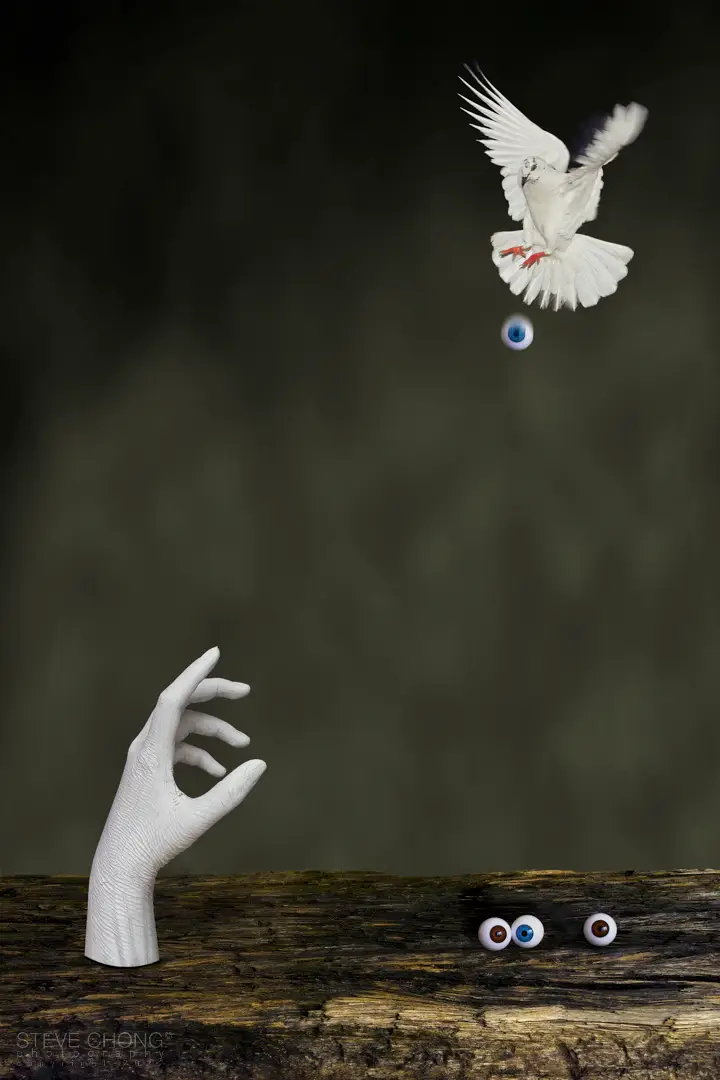
Retrieval and Despair
January 2004 · Conceptual
At the beginning of the year, a flock of pigeons appeared in front of my house. Every morning, when the sun rose, I found them standing in a line on the cable. I was curious why they were there. On a whim, I grabbed a handful of rice and scattered it. The pigeons on the cable were obviously attracted. Like B-52s, they swooped down. The front of the house was filled with the cooing of a large flock of pigeons and the plop of flapping wings. It was a lively scene.
The next day, they returned on time. Interestingly, their heads were always facing the front of the house. It seemed they understood that this place served breakfast.
Looking at these pigeons, somehow an image appeared in my thoughts. Those "eyes and hands" were chasing away the pigeons.
For several days, this image haunted my mind.
Then I decided to bring the scene to life.
When photographing birds, you can never have too long a focal length. If you have 400mm, you want 800mm, and you want to capture the finest feathers of the bird. In bird photography, focal length means power.
However, I only had a 24-70mm on hand, which I am afraid would make even the most poorly equipped bird photographer laugh.
Since I was under-equipped, I had to make the most of it. Fortunately, the distance between me and the pigeons was not very far. Under 70mm, the pigeon in the frame was about the size of a finger. For the needs of my composition, this was enough.
To have a clean background, I hung a piece of black cloth on the railing.
I added a flash to capture the rapid movement of the pigeon. Everything was ready, and I got down to work immediately.
“In bird photography, focal length means power.”
After scattering the rice, the pigeons probably noticed that the situation was a little different from usual. There was a black cloth and a sneaky guy standing not far from it. They hesitated. But finally, hunger seemed to overcome their doubts, and one pigeon took the lead and swooped down. Then the rest followed.
I hurriedly pressed the shutter. Because of the limited recycle time of the flash and the focal length, the situation was quite chaotic. I had to shoot almost blindly, hoping to catch my prey.
After a morning of hard work, I finally got an ideal shot of a dove.
Then I started to arrange the "eye and hand" setup. I had become more familiar with the technique after a few earlier shots, and I had a particularly clear image in mind. The shoot went well, but it still took most of the day.
In post-production, I incorporated the dove with the "eyes and hands" image, and finally, the concept was completed.
Have you ever photographed white doves? Tell us about your experience.
Studio
Sigma SD9 · ƒ/8 · 1/250s · ISO 50 · 70mm